
Tech Insights
Keeping Cold Plates Clear: Inline Turbidity Monitoring for Data-Center and AI Server Liquid Cooling
As AI servers and high-density racks push more facilities toward direct-to-chip liquid cooling, coolant cleanliness has become an operational concern. Particles in the loop can foul cold-plate microchannels and degrade heat transfer. This article explains where contamination comes from, what continuous turbidity monitoring can (and cannot) tell you, and how YuanGan’s compact low-range ISO 7027 sensor YG-T1B can support side-stream, CDU secondary-loop, and filter monitoring once media compatibility and sample conditions are confirmed.
Why Turbidity Matters in a Liquid-Cooling Loop
In a direct-to-chip system, a coolant distribution unit (CDU) circulates coolant through cold plates mounted on CPUs and GPUs. The coolant picks up heat in fine microchannels, returns to the CDU, rejects heat, and recirculates in a closed loop. Because those channels are narrow, the amount of suspended material in the coolant has a direct bearing on whether flow stays unrestricted.
Turbidity measures how strongly suspended particles scatter light. It is a practical, continuously measurable proxy for coolant cleanliness. Where periodic grab samples give you a snapshot, an inline turbidity sensor gives you a live trend — so changes can be spotted before they become a thermal or availability problem.
Common Sources of Particles and Contamination
Based on general industry experience, particulates can enter a cooling loop at several stages:
- Installation and commissioning: weld slag, machining debris, or sealant fragments left behind when flushing is incomplete.
- Normal operation: corrosion products from wetted metals, precipitation from aging inhibitors or other additives, and sloughing biofilm.
- Make-up and maintenance: variable quality of make-up water or top-up coolant, and contaminants introduced during service work.
Once these particles settle in cold-plate microchannels, quick-disconnects, or heat exchangers, they can raise pressure drop, reduce local flow, and lower heat-transfer efficiency — and in severe cases, clog channels outright. Early detection is the core of effective coolant quality management.
What Inline Turbidity Monitoring Delivers
- Closed-loop trend monitoring: Log secondary-loop coolant turbidity continuously, establish a baseline for normal operation, and treat a sustained rise as an early warning of contamination or accelerating corrosion.
- Filter condition insight: Measuring at key points such as upstream and downstream of filters, alongside differential pressure, helps indicate when filtration performance is falling off and elements need service.
- Make-up water gatekeeping: Monitor the make-up line so off-spec fluid is caught before it enters the closed loop.
- Flushing and commissioning checks: Watch turbidity in real time during flushing to support decisions on when the system is clean enough to hand over.
- Alarm integration: Feed digital or analog signals to the CDU controller, PLC, or facility / DCIM monitoring platform and set alarm thresholds for automatic notification.
Turbidity is an aggregate indicator best suited to trending and early warning. Questions about particle size distribution or chemical composition should still be answered with laboratory analysis and complementary water-quality parameters.
YG-T1B: A Compact Low-Range Sensor for Industrial Continuous Monitoring
The Low-Range Turbidity Sensor YG-T1B from YuanGan is based on the ISO 7027 standard. It is compact, delivers stable data, and responds quickly. It is widely used for online turbidity monitoring in water treatment plants, wastewater plants, surface water, and industrial applications.
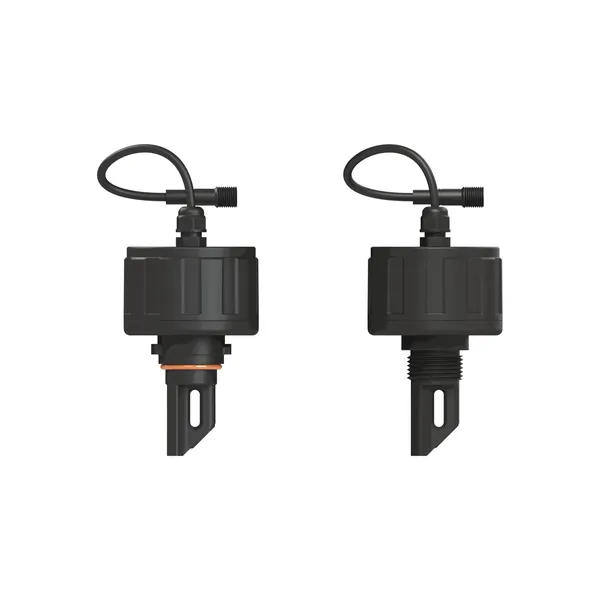
For liquid-cooling projects, YG-T1B can be considered for continuous particulate trending on a side-stream sample line, on the CDU secondary loop, or around filters — after media compatibility and sample conditions have been confirmed. It is not a model purpose-built or specially customized for semiconductor or liquid-cooling duty; it is a general-purpose compact low-range sensor for industrial continuous monitoring.
Where the loop uses glycol-based coolants (for example ethylene glycol or propylene glycol blends), selection must separately verify that the sensor’s wetted materials are compatible with the coolant. Glycol compatibility must not be assumed.
Key features
- Compact size: easy system integration
- Simple structure: easy to clean and maintain
- Beveled optical window: bubbles do not easily adhere
- Sealed structure: withstands deep water or high pressure
- IP68 protection: submersible installation possible
Technical specifications
- Range: 0–100 NTU (default); 0–1000 NTU
- Resolution: 0–100 NTU: 0.001 NTU; 0–1000 NTU: 0.01 NTU
- Limit of detection: 0.005 NTU
- Accuracy: 0–100 NTU: 2% or ±0.05 NTU (whichever is greater); 0–1000 NTU: 5% or ±0.5 NTU (whichever is greater); (based on Formazin primary standard at 25 °C)
- Repeatability: ≤1% (based on Formazin primary standard at 25 °C)
- Zero drift: ≤1.5%
- Reading stability: ≤1.5%
- Measurement method: 90° light scattering (ISO 7027)
- Light source: 860 nm laser
- Calibration: Factory-calibrated with the default calibration curve; one-point, Formazin two-point, or 2- to 6-point custom calibration
- Ingress protection: IP68
- Operating pressure: ≤1 MPa
- Operating temperature: -5–45 °C
- Operating voltage / peak power: DC 9–28 V / 5 W
- Housing material: Standard: ABS; optional probe section: 316L stainless steel
- Digital output: RS485 Modbus
- Analog output: 4–20 mA
- Dimensions / mounting: 117 mm × Φ64; RBMS
- Model: YG-T1B
*Specifications may change with product improvements; YuanGan reserves the right to modify them.*
Installation and Integration Guidance
Side-stream sampling. A bypass (side-stream) arrangement is generally recommended — on the CDU secondary loop, around filters, or on the make-up line — so the sensor can be serviced without interrupting the main loop. Confirm that sampling-point pressure and temperature fall within the sensor’s rated limits: operating pressure ≤1 MPa and operating temperature -5–45 °C.
Flow cell and mounting fixture. YG-T1B measures 117 mm × Φ64 and uses RBMS mounting. A matching flow cell or mounting fixture can be selected to integrate the sensor into the bypass sample line, based on sample flow, pipe interfaces, and media conditions at the site.
Signal integration. With both RS485 Modbus and 4–20 mA outputs, the sensor connects readily to CDU controls, PLCs, or data-center / DCIM monitoring platforms for data acquisition, trending, and alarm interlocks.
Make Coolant Quality Visible
Coolant is the lifeblood of a liquid-cooled server fleet. Adding turbidity to your continuous monitoring gives operations teams early visibility into particulate and contamination changes, supporting smarter filter maintenance, make-up management, and reliable uptime. YuanGan designs and manufactures online water-quality sensors and can support sensor selection based on your sampling conditions, media compatibility requirements, and integration needs.
Talk to our team for YG-T1B datasheets and application support for your liquid-cooling project:
- Email: yan@yuangankeji.com
- WhatsApp: +86 15178830466
- Phone: +86-400-1688-667